
To facilitate inner healing, you need a way to open your heart and choose the intent to learn. Here are some ways to do that.
When it comes to doing inner parts work, I appreciate the directness and simplicity of Inner Bonding® (click here for my brief description of how the process works.) Here are the six steps of the process:
- Be willing to feel your feelings
- Move into the intent to learn
- Dialogue with your inner child and your wounded self
- Dialogue with your spiritual guidance to learn what loving action might be needed
- Take the action
- Evaluate the results
There’s more to each of these simple steps, of course. However, seeing them laid out like this, you can fully take in the power of the process. Most importantly, you can see that Steps One and Two have to come first.
What is the big deal about “the intent to learn?”
Having worked with many people over the years, I’ve seen that trying to have an internal dialogue when you aren’t truly in the intent to learn (Step Two) is the most common block to progress. If you aren’t in the intent to learn, then by default, you are in the intent to control. These are your only two options.
Why is the intent to control a problem? Because when you are in the intent to control, you aren’t willing to feel your feelings. Instead, you try to protect yourself from feeling them. You might do that by
- Repressing
- Minimizing
- Judging
- Numbing
This control challenge comes up in any kind inner parts work, not just Inner Bonding®. We need a way to address it. So far, so good. But—how exactly do you do Steps One and Two? To put this another way, how do you open your heart and choose the intent to learn?
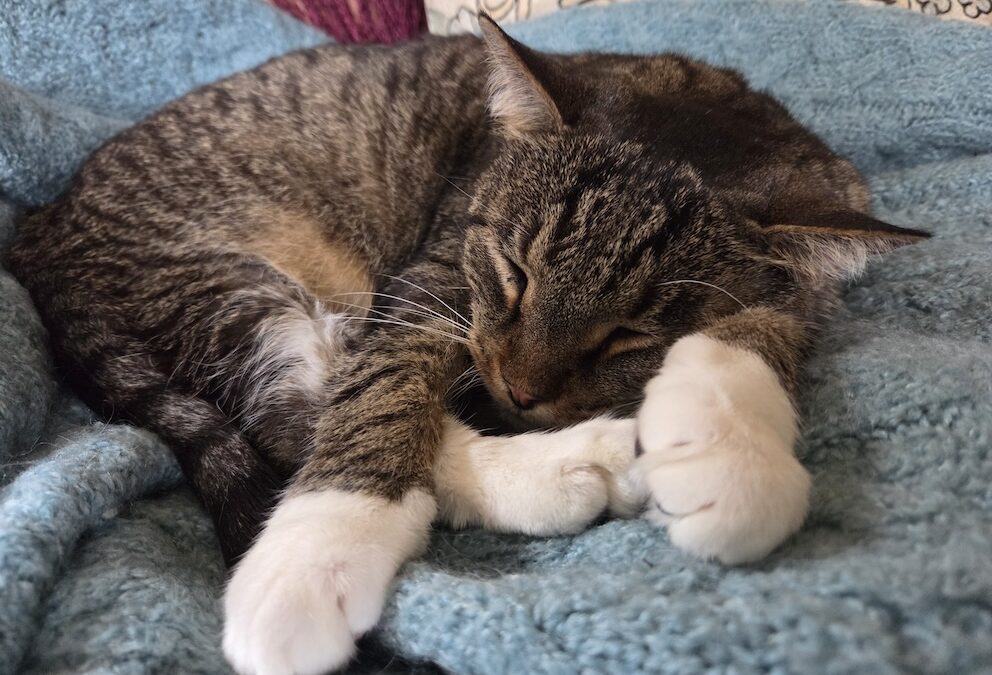
I can tell you what works for me. I snuggle with Leo, our 16-year-old brown tabby cat. I had a terrible cold a few days ago. I woke up feeling so awful, that I went right back to bed and stayed there for six hours. Leo snuggled up against me under the covers, the entire time.
I felt lousy. At the same time, I felt pure bliss. An unusual combination, for sure…but there is absolutely nothing I’d rather do than snuggle with a cat, and Leo is a particularly sweet cat.
Suffering is optional
To my surprise, I suffered much less than I typically would—because with Leo’s help, my heart stayed open. Lying there with him, I fully felt all my feelings: the aches and the fatigue, and the Leo-induced bliss.
In fact, simply having Leo around and interacting with him throughout the day really helps me do Steps One and Two. I find it easier to keep my heart open and to be curious about what’s going on in me (or in other people), rather than trying to avoid my feelings using any of the methods I described above.
Even if you don’t have a cat, you’ll find heart-openers that work for you in this list. I’ve done all of them at one time or another myself. The list comes from Margaret Paul and Erika Chopich’s book about Inner Bonding®, Do I Have To Give Up Me To Be Loved By God (p. 156):
- Listening to music
- Taking a walk
- Being in nature
- Talking with a friend
- Reading spiritual literature
- Journaling
- Drawing or doing other artwork like sculpture or collage
- Dancing
- Attending Twelve-Step or other support-group meetings
- Playing with a child or pet
- Being held by a loving person
- Letting yourself cry
- Releasing your anger by yelling and pounding
Do any of these items call to you? Do you remember to do them when you are struggling?
Bridges to learning
Margaret and Erika call these “bridges to learning,” because they give you a way to get from a wounded, resentful, controlling state back into the intent to learn. Prayer and gratitude are the most powerful bridges. Generosity is a powerful addition. You can ask yourself, “What can I give to myself and others?” As HSPs, we easily give to others. That’s great. But we also need to include ourselves on the list of recipients of our attention and care. I’ve found it’s better for everyone when I do that.
Staying in bed with Leo that day was a great example. I gave myself the gift of rest. As a result, I felt such gratitude, not only for him, but simply for being alive. It’s a family joke that not a day goes by that I don’t say, “Can you believe we have a cat?! Isn’t it amazing?” Margaret and Erika would call that a “prayer of gratitude.”
They are right. I have always yearned to have a cat, and now I have one. Leo is an old guy, with old guy problems like arthritis and a permanent cold. In fact, in selecting a picture for this post, I had to discard my favorite close-up of him: when I enlarged it, I realized you could see a ribbon of mucus emanating from his nose. But I adore him. He opens my heart, messes up my schedule, and makes me laugh. Good things come out of all that, including the idea for this post. Thank you, dear Leo.
What humans, animals, or actions in your life affect you like this? Do you allow yourself time and space to enjoy them?
Note: This newsletter is 100% human. I wrote it, with no AI assistance.
Image: ©2026 Emily Agnew

















Hi Emily. The thing that most reliably helps me get in the intent to learn is to strongly engage as many muscles as I can. For example: doing a few slow squats while holding a 10 lb weight, or doing some slow wall pushups.
I have also noticed lately that after doing about 20 minutes of somatic exercises, I feel much more grounded and open. These exercises also engage muscles but in a more subtle way.
So, for me, it is something about engaging my muscles that makes me feel grounded, alive, and safe.
Kim