
HSPs famously try to “do it once and do it right.” This can be an effective strategy, but it carries the risk of painful perfectionism.
I’ve never been a custard pie fan. However, my mom’s custard pies were transcendent. Everyone else in the family loved them. That’s why, when my sister managed to locate the recipe last week, my brother teasingly challenged me to bake a custard pie. He hoped my tastebuds “had matured enough to appreciate this nectar of the gods.”
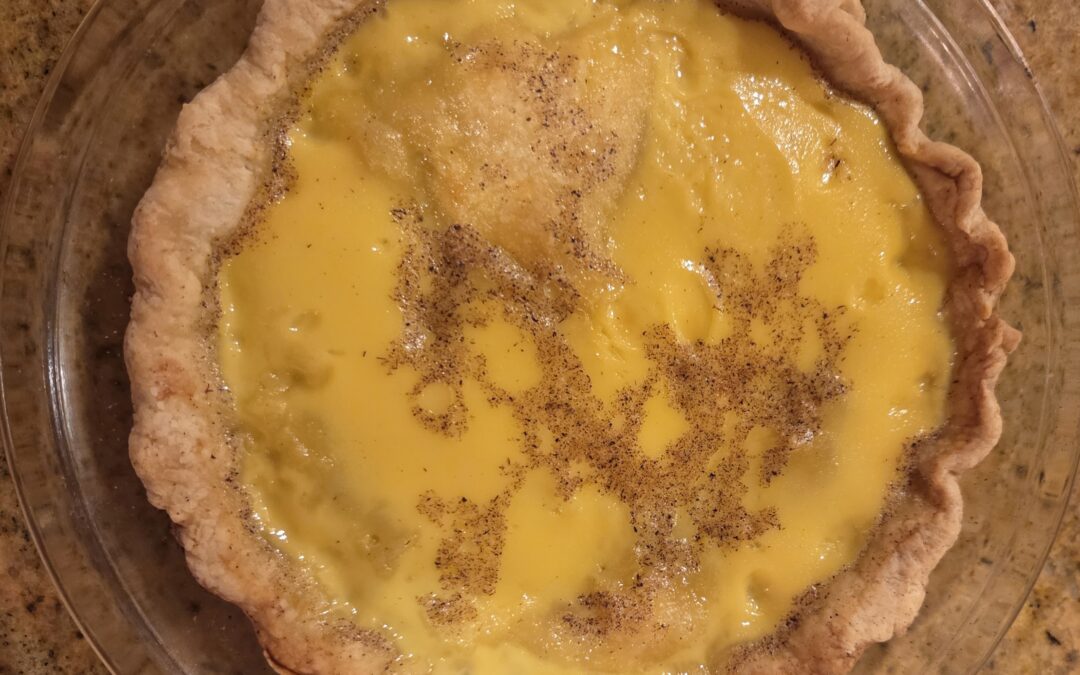
I don’t know if my taste buds have matured or not, because the pie I baked last week came out all wrong. When I pre-baked the crust, it shrank down the sides of the pie dish. At the same time, the floor of the crust ballooned. The small amount of custard I could fit in the remaining shallow space could not cope with these seismic forces. The surface of the custard ended up cratered, like the moon, and the grated nutmeg redistributed itself into a strange amoebic pattern.
“No matter!” I bravely said. “I’m sure it will taste fine!” It did not. I had overbaked the pie. This fatal error, Google informed me, explained why custard had toughened and turned granular, releasing pools of liquid. The liquid ran into the above-mentioned craters, forming tiny lakes. Looking at it, I wanted to weep.
Why was I so upset—over a pie?
Why was I so upset? I pondered this all week. First, I realized that my mom’s recipe contained no explanatory details at all. She had listed the ingredient amounts, the temperatures, and the baking times. That was it. Then it hit me that, most uncharacteristically, I had not tried to fill the information gaps by looking at custard pie recipes online. I simply plunged into the pie-making process. In doing so, I had ignored the cherished HSP pledge to “do it once and do it right”…and I had suffered the consequences.
“Do it once and do it right” is so typical of HSPs that Elaine Aron put it third on her list of 18 distinguishing HSP characteristics. She describes it as “wanting to consider every detail and possible outcome before acting…as opposed to the majority’s tendency to decide more quickly.”*
I didn’t consider every detail. Instead, I learned why I prepare so carefully: to protect myself from pain. In this case, there was the pain of disappointment, but there was more.
Protecting from pain
I didn’t see the pain coming. I had looked forward to sending pictures to my brother of an Instagram-worthy creation. I had even (rashly) told friends I’d bring the pie over that night for dessert. (I did, but the occasion felt more like a post-mortem than a feast.)
However, I understand now that there was more to my distress than just a ruined pie and some embarrassment. On a deeper level, this minor disappointment tapped into a well of sadness. I’m grieving. Three more dear people in my life have died recently. And through it all, I miss my mom.
Intense emotions like this are, of course, another key HSP characteristic. Perhaps this helps explain why we try to “do it once and do it right.” We feel so much already. No wonder we use the strategy of careful preparation to try to avoid yet more intensity, whether it be disappointment, or grief, or the overarousal that can result when we don’t plan well and things go south.
Our “do it once and do it right” approach has great strengths. However, it comes with a major pitfall: perfectionism. Getting it right the first attempt every time simply isn’t feasible. If I can lighten up on the “get it right” part, I can give myself opportunities to practice without the painful disappointment. My mom certainly had lots of practice. During her lifetime, she made dozens of creamy, silky custard pies. Maybe the first few came out cratered and grainy like mine did.
I can’t protect myself from existential pain, like the grief of losing people I love. I wouldn’t want to. But I can protect myself from unnecessary suffering, by putting aside perfectionism in favor of an experimental attitude. Then I can “do it once as well as I can and learn what I need to do to do it even better next time.” That’s wordier than the original, and way, way more helpful.
*Aron, Elaine (2010): Psychotherapy and the Highly Sensitive Person, New York: Routledge, p. 6.
Photo: ©2026 Emily Agnew
Note: This newsletter is 100% human. I wrote it, with no AI assistance.
















Emily,
I love your writing. I have read everything on your blog and I’ll read anything you publish next. Thank you for being you. I’m blessed to live in a world where you share your thoughts with us.
Thank you Anonymouse:) I really appreciate it.